

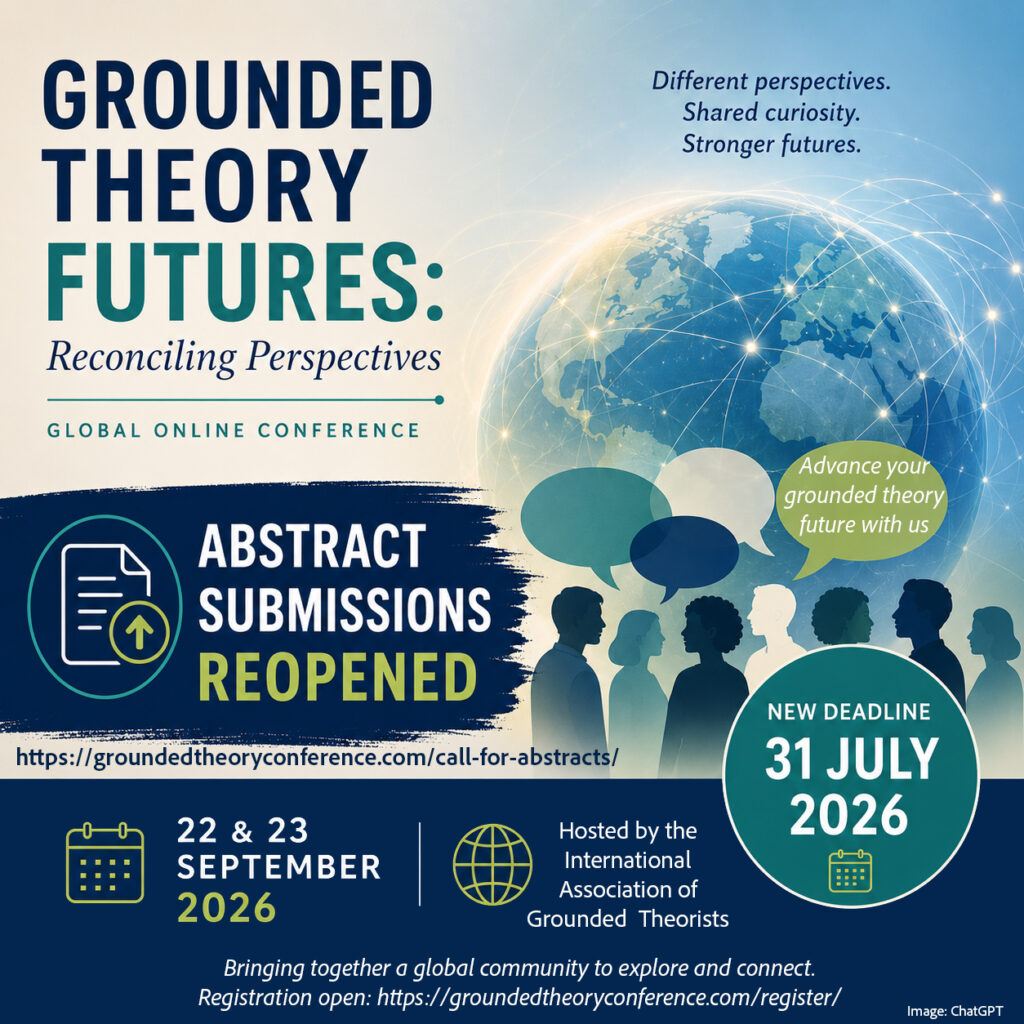
Grounded Theory Futures: Reconciling Perspectives
Tuesday 22nd & Wednesday 23rd September, 2026
Keynotes, panels, oral presentations and posters
The conference will offer a mix of keynotes, symposia, oral presentations and poster-presentations, online. We welcome abstracts of grounded theories from any area of interest and from any disciplinary background as well as methodology papers that seek to expand and develop grounded theory.
Panels
Submissions are welcome for panels presentations. The panel should focus on a specific theory, concept, or methodological consideration. Panel presentations include an organiser/moderator, who presents an “anchor” paper, which also introduces speakers who have contributed papers relating to the topic of the anchor paper. The papers should offer an in-depth discussion of related ideas or different perspectives on the same theory, concept, or method.
Each 60-minute panel will consist of 4-5 speakers . Each speaker will be allotted 10 minutes per presentation. Following the presentations, a 10-minute question and answer session will be led by the moderator/organiser. The question/answer period should be used to clarify, advance, and expand the conversation on the topic, with a view towards inspiring continued debate.
The panel organiser/moderator must coordinate the speakers and submit an abstract regarding the panel including all participants’ names, academic qualifications, affiliations, presentation titles, and short descriptions of their presentations. All panel presenters must register for the conference.
Please email panel proposals to: proposals@groundedtheoryconference.com
The symposium abstract should be 300 to 500 words and will be evaluated against the following criteria:
Oral presentations and poster-presentations
We welcome abstracts of grounded theories from any area of interest and from any disciplinary background as well as methodology papers that seek to develop grounded theory.
A methodology paper should present a new or unique perspective on grounded theory that moves the method forward. Methodology presentations can present, for example, innovations in areas such as data gathering whereby the richness and diversity of data sources is improved. Presentations can also focus on explanations or clarifications of an element of the method that is misunderstood by broad scholarly audiences.
Guidelines for abstract submissions: oral presentations and poster-presentations
Abstracts of 300-500 words are invited for oral presentations and poster-presentations.
Oral presentations of 20 minutes will be pre-recorded and followed by a 5 minute question and answer sessions led by the presenter. Poster presentations can take the form of an .pdf image or a short video.
All abstracts will be evaluated agains the following general criteria :
Oral, theory presentations and poster-presentations will also be evaluated against the following six criteria:
Methodology presentations will be evaluated against the 3 general criteria and the following two criteria:
* For example, Glaser’s classic grounded theory; Strauss & Corbin’s grounded theory; Charmaz’ constructionist grounded theory; Clarke’s situational analysis.
Abstract structure
Submissions are restricted to one oral presentation per first author/presenter.
.